Wine Cooler Repair
Sub-Zero Wine Cooler Zone Drift: What Six Degrees Means
When one zone of a dual-zone Sub-Zero sits four to six degrees off setpoint, the compressor is usually fine. The damper, thermistor or door seal is not.
Words by
Dean Halvorsen
- Role
- Refrigeration technician — sealed systems and airflow
- In the trade
- 19 years
- Holds
- EPA 608 certified
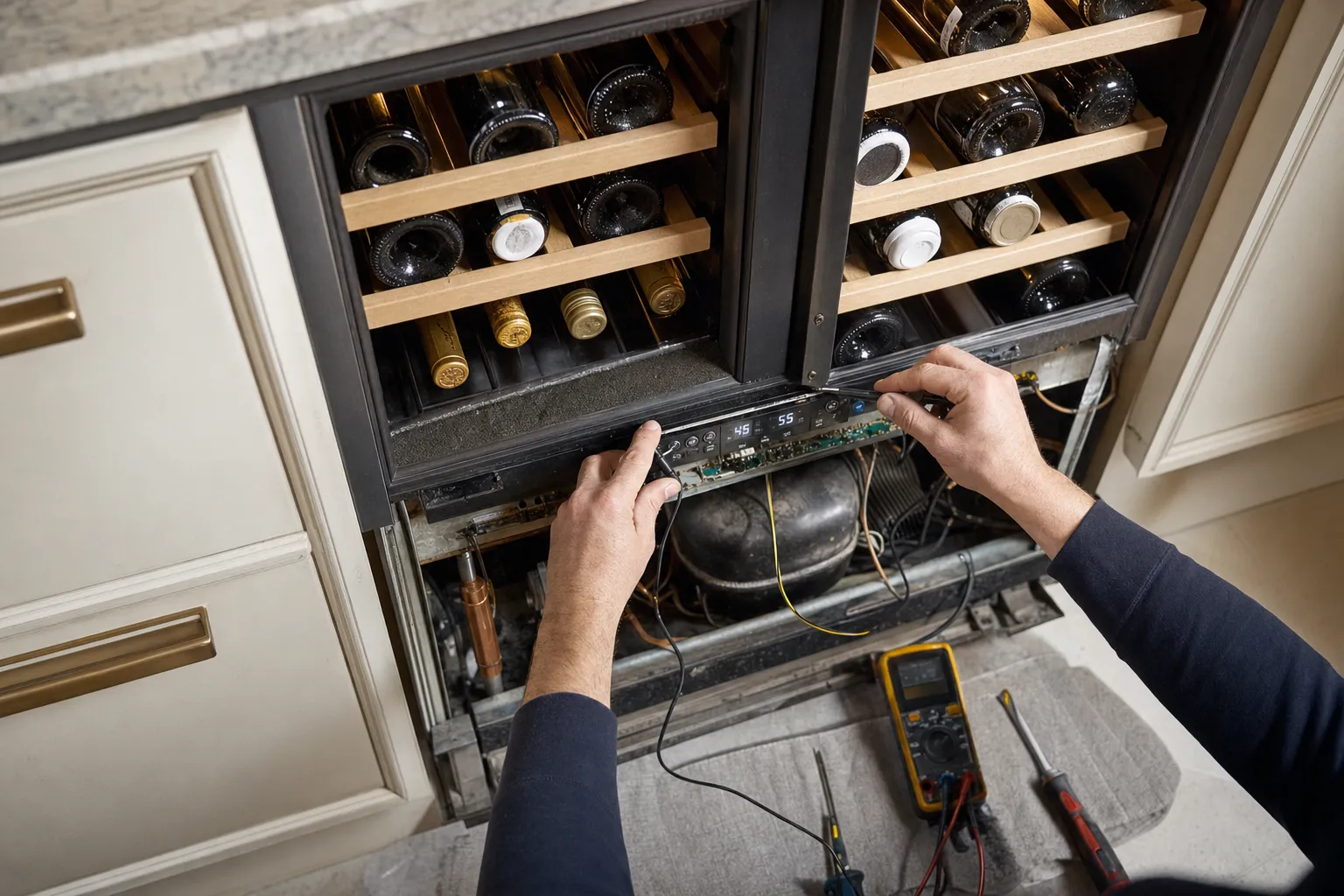
A dual-zone Sub-Zero wine cabinet is doing something more difficult than a refrigerator. It has to hold two different temperatures, often only ten or twelve degrees apart, using a single sealed system and a set of controlled air paths. It does this well for years, and when it stops the failure is nearly always in the controlling parts rather than in the refrigeration itself.
The call usually comes in the same way: the upper zone is set to 55°F and reading 61°F, or the lower zone will not come down past 50°F however low the setpoint goes. The compressor runs. The lights work. One zone is simply wrong, and it has been wrong for months before anyone rings.
Read both zones before you conclude anything
The single most useful thing you can do is write down four numbers: what each zone is set to, and what each zone is actually reading, at the same moment. The relationship between those four numbers is most of the diagnosis.
One zone off, the other correct. This is the common case and it is good news. The sealed system is producing cold — the other zone proves it — so the fault is in how that cold is being distributed or measured. Damper, thermistor, or that zone’s fan.
Both zones off in the same direction, by about the same amount. Now the refrigeration itself is under-performing, or the condenser cannot reject heat. On a built-in unit in a tight cabinet run, a blocked condenser is the first thing to rule out, and it is often just years of dust.
Both zones reading correctly but the unit runs constantly. Something is loading the cabinet — a door not sealing, a failed door heater running continuously, or a unit installed somewhere genuinely hot.
One zone wildly off, the other slightly off. Usually a damper that has stuck part-open, which robs one zone while over-cooling the other.
Take the readings with the door shut for at least four hours beforehand. A cabinet you have been opening all evening will not tell you anything true.
The damper is the usual answer
In a dual-zone cabinet, cold air is generated in one place and portioned out. A motorised damper opens and closes an air path to the second zone, and the control board moves it based on what that zone’s thermistor reports.
Dampers fail in a way that is easy to recognize once you know it. They stick. The motor or the linkage stops moving the flap fully, and the zone it feeds is either permanently starved — sitting several degrees warm and never getting there — or permanently flooded, running colder than its setpoint no matter what you do.
The tell is that the error is stubborn. A damper fault does not wander. Change the setpoint and the zone moves by roughly the same offset and stays there, because the air path is physically wrong and no amount of control logic fixes a flap that will not move.
The second candidate is that zone’s thermistor. A drifted thermistor produces the same warm reading for the opposite reason: the damper works, but the board is being told a lie about how cold the zone already is, so it never calls for more. Those two are told apart with a meter, and it is a ten-minute test on site.
What to check before booking
A few things are worth ruling out yourself, because they are free and they are occasionally the whole story.
Check the condenser. On most Sub-Zero wine units it is behind the lower grille, and it collects dust, pet hair and kitchen grease. A blanketed condenser cannot reject heat, and the first symptom is a cabinet that no longer reaches the bottom of its range on warm days. Pull the grille and look. If you cannot see through the fins, that is your afternoon.
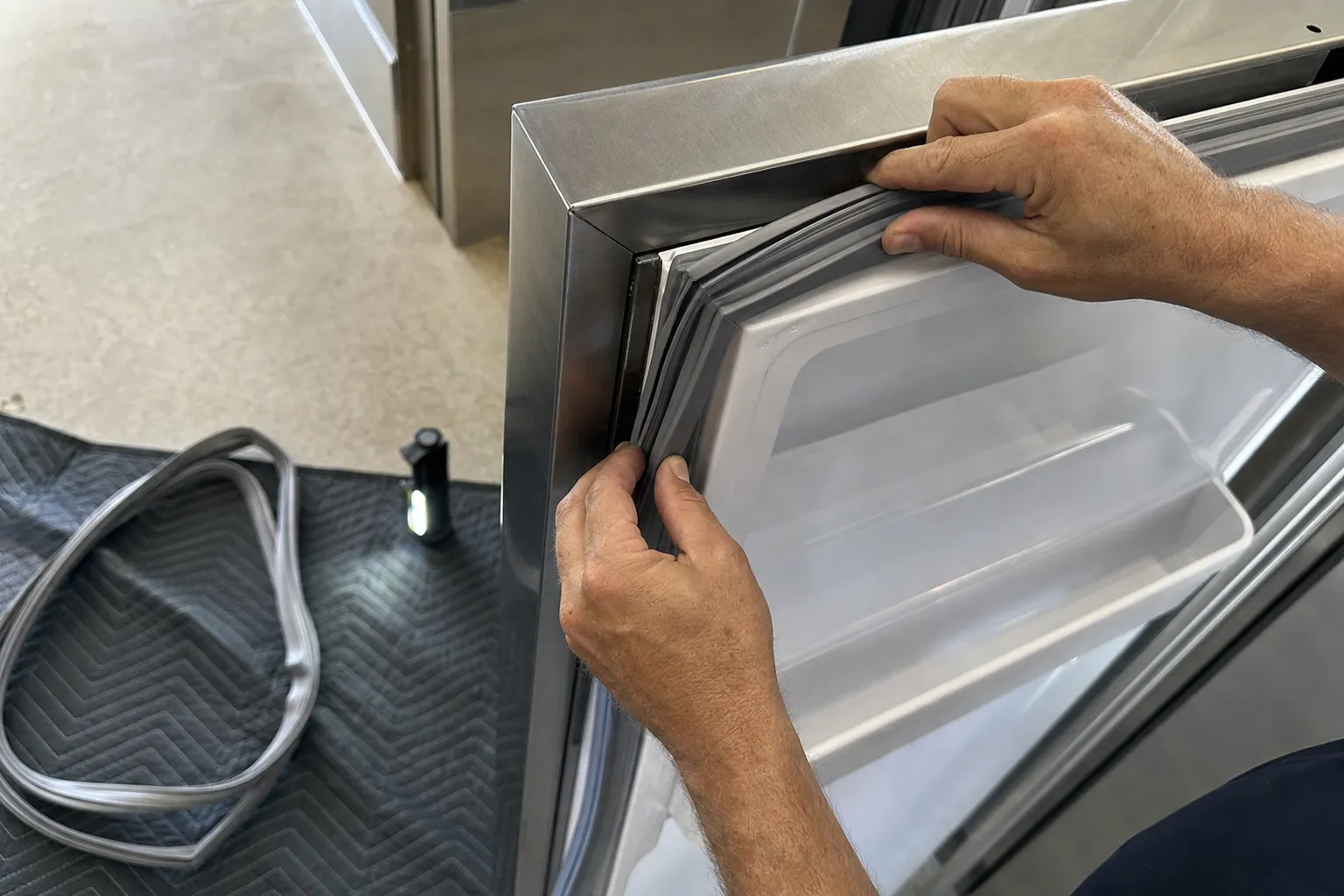
Check the door. Work a strip of paper into the seal, shut the door on it, then drag it back out — wherever it comes free without gripping, the gasket has lost contact with the frame and that section is doing nothing. Hardened gaskets are common on units installed in sunny rooms, and around the Tacoma waterfront the summer humidity makes a marginal seal show up faster than it would inland.
Check what is around it. An undercounter wine cabinet installed with no clearance, or one sitting next to a dishwasher that runs every night, is being asked to do something the specification does not cover.
Check the load. Bottles racked hard against the rear wall stand directly in the air path, and whichever zone sits furthest downstream of the vent pays for it in degrees. That is not a fault.
Why waiting costs more here than elsewhere
Zone drift is easy to live with, which is exactly why it turns into an expensive repair. A cabinet that is four degrees warm still looks like it is working, so it gets ignored for a season, then two.
Meanwhile the system is running far more than it was designed to. A stuck damper means one zone is never satisfied, so the control keeps calling for cooling, and the compressor accumulates run hours at a rate the unit was never specified for. The part that would have fixed it in month one is inexpensive. The compressor and sealed-system work that follows two years of continuous running is a different conversation, and on a built-in cabinet it is the point at which people start pricing replacements.
There is also the contents to think about. Sustained warmth in the high 50s ages a bottle faster than it should, and repeated swings push corks. If the cellar in the cabinet is worth anything, the arithmetic on fixing it early is not difficult.
When it is worth the call
Book it if a zone has been more than three or four degrees off for more than a couple of weeks, if the offset does not change when you change the setpoint, if the compressor runs continuously without either zone reaching target, or if the glass is fogging on the inside.
Have the model number ready — 424, 427, IW-30 and the newer designer wine columns all behave differently — along with your four numbers, both setpoints and both actual readings. That is normally enough to know whether the damper motor and the thermistor should be packed before anyone sets off.
Either way the service call ends in a reading rather than a guess: both zones logged against their setpoints, the damper and the thermistor tested, and the figure agreed before a part is fitted.
Common follow-ups
How far from its setpoint can a wine zone sit before it matters?
Small swings of a degree or two as the cabinet cycles are normal and do no harm. A zone that sits consistently four degrees or more away from its set value, or that never reaches it at all, is a fault worth diagnosing before it becomes a compressor problem.
Does zone drift damage the wine?
Short-term drift of a few degrees does not ruin a bottle. Sustained warmth in the high 50s accelerates aging, and repeated swings are worse than a steady wrong temperature because they push the cork. Fix it within weeks, not months.
Why does the glass door fog on the inside?
Interior condensation means warm humid air is reaching cold glass — usually a failed door heater circuit or a gasket that is no longer sealing. It is a separate fault from zone drift, though the two often turn up on the same unit.