Freezer Repair
Sub-Zero Freezer Frosting Over: Reading the Defrost Circuit
A frost slab on the rear freezer panel is almost never a bad compressor. It is a defrost circuit that stopped completing, and three parts decide which.
Words by
Dean Halvorsen
- Role
- Refrigeration technician — sealed systems and airflow
- In the trade
- 19 years
- Holds
- EPA 608 certified
Frost on the back wall of a Sub-Zero freezer gets read as a failing compressor more often than any other symptom on the list, and it almost never is. A compressor that is dying does not build ice — it fails to make cold, and the whole compartment climbs steadily. Ice is the opposite problem. The machine is making plenty of cold. It has just stopped getting rid of the frost that making cold produces.
Every frost-free freezer runs a defrost cycle for exactly that reason. Air moving over an evaporator coil deposits its moisture there as ice; a heater near that coil warms it periodically, the meltwater runs to a drain, and the cycle repeats. When somebody says their Sub-Zero freezer is “icing up”, what they are describing is a cycle that is no longer completing.
What the frost pattern actually tells you
Where the ice forms narrows the fault before anyone opens a panel.
- A hard sheet across the rear evaporator panel, thick enough to muffle the fan, is the classic stalled defrost cycle. The coil ices, the fan can no longer push air through it, and the compartment starts to drift up even though the compressor is running constantly.
- Ice building at the bottom of the compartment, under the baskets, points at the drain rather than the heater. Meltwater is being produced and then freezing before it can leave.
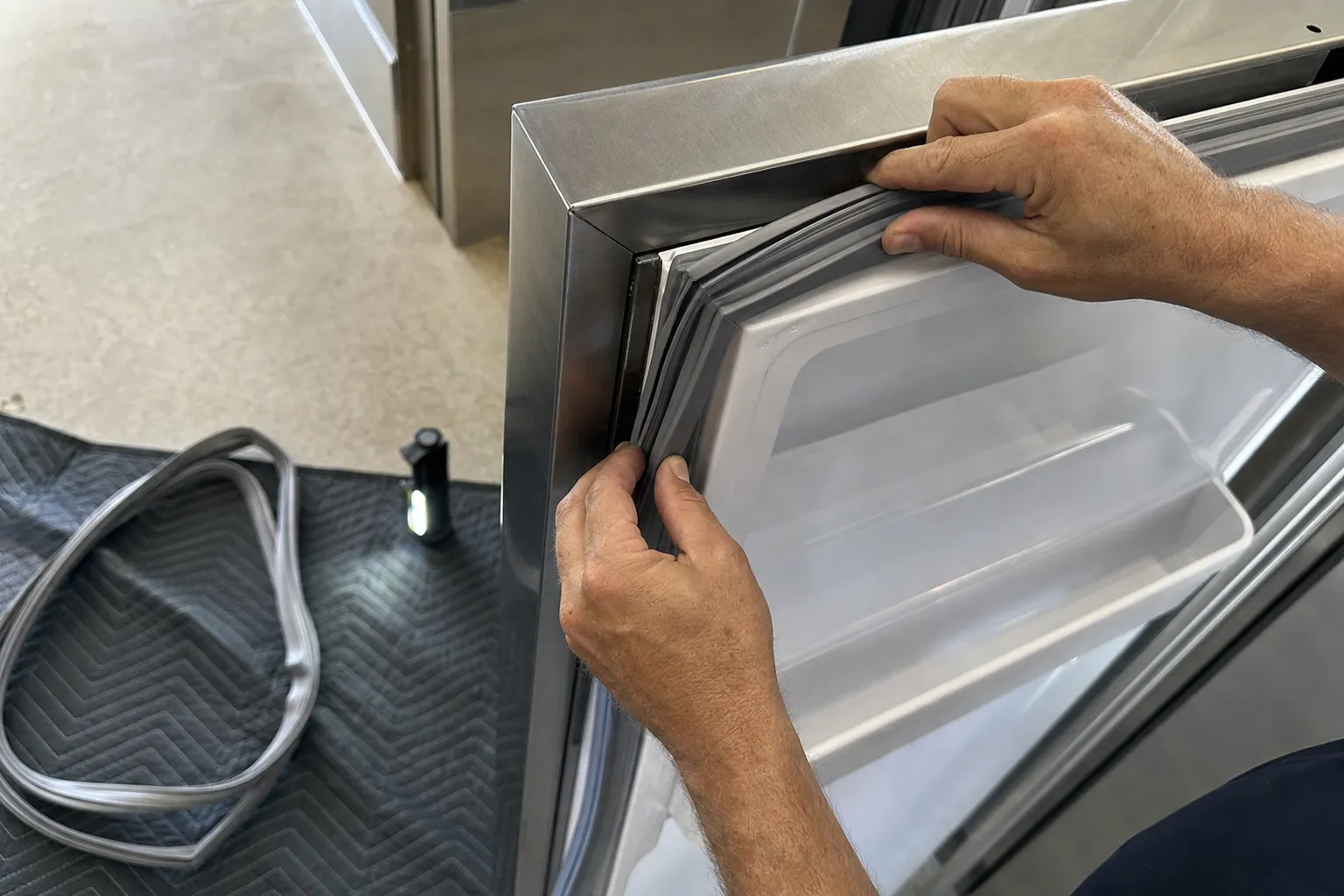
- Frost around the door frame and gasket only, with a clean evaporator panel, is a sealing problem — humid Tacoma air getting in past a gasket that has gone hard, or a door that is not pulling fully closed.
- A light, even dusting that comes and goes is the system working. Leave it alone.
Those are four different repairs. Grouping them all as “icing up” is what leads to the wrong part being ordered.
The three parts in the defrost circuit
On a Sub-Zero, defrost is not one component. It is a small chain, and the whole chain has to complete for the cycle to run.
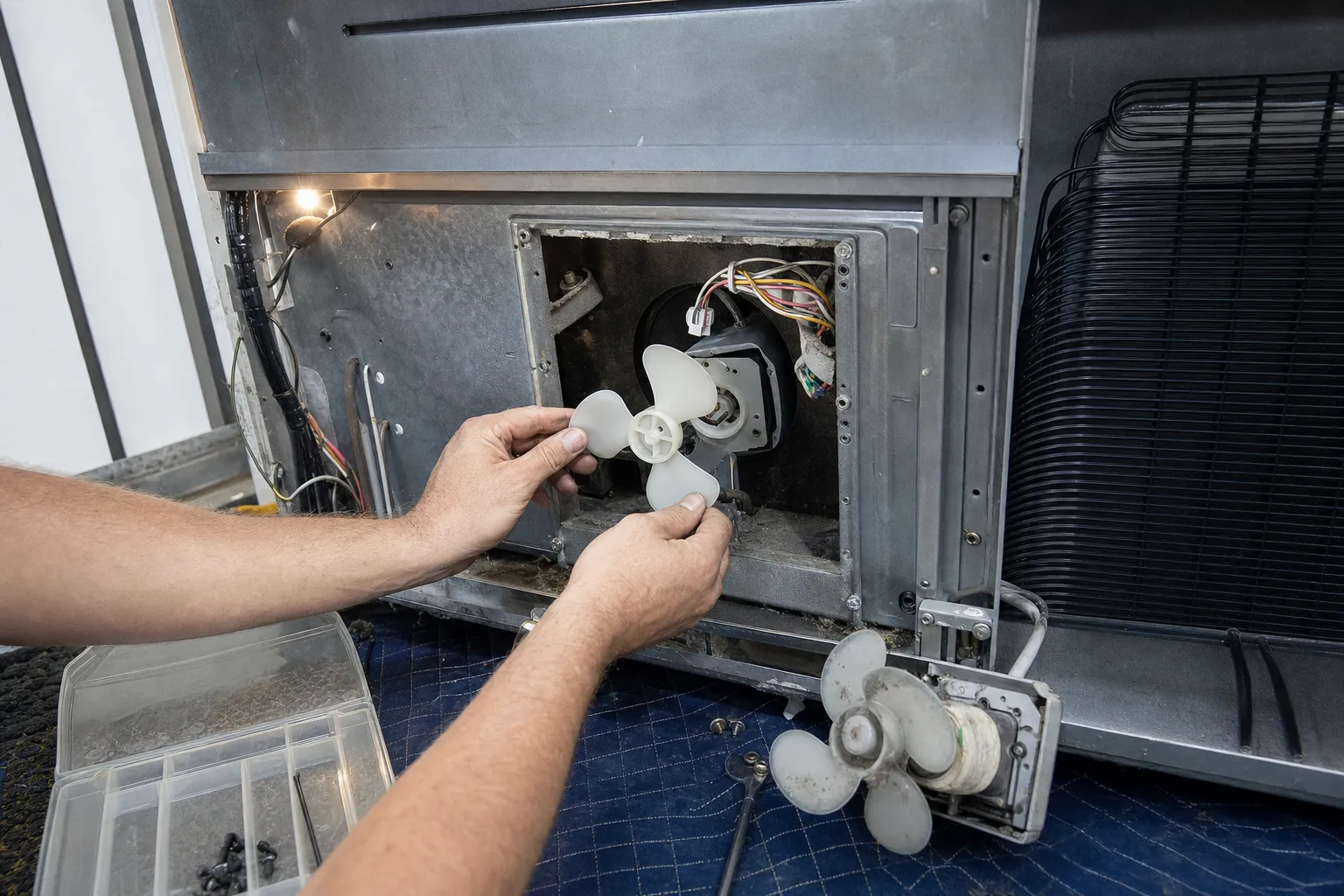
The defrost heater is nothing cleverer than a resistance element run along the evaporator, and melting the frost is the whole of its job. It does not weaken; it goes open, which means dead, which means no heat at all rather than a bit less than before. That is why the resulting ice build-up is so orderly — a little worse each week, on a schedule, until the fan is buried.
The defrost thermistor tells the control board what the coil temperature is. If it drifts or fails, the board either never initiates a defrost because it believes the coil is already warm, or it terminates the cycle far too early. A thermistor fault often looks intermittent — a few good weeks, then a bad one.
The drain and drain heater carry the meltwater away. Sub-Zero routes that water down a tube to an evaporation pan. If the tube ices at the entry point, the defrost cycle runs perfectly and the water simply has nowhere to go, refreezing at the bottom of the compartment.
There is a fourth possibility that costs nothing to rule out: a door left ajar, or a gasket letting humid air in continuously. No defrost cycle keeps up with a door that does not seal, and around Commencement Bay the summer humidity is more than enough to make that visible.
The 24-hour test worth doing first
Before you book anything, there is one test that separates a defrost fault from everything else, and it costs you nothing but a day.
Empty the freezer into a cooler or another appliance. Switch the compartment off at the control panel — not at the breaker, so the rest of the unit keeps running — and leave the door open with towels down for a full 24 hours. Every trace of ice has to go, including what you cannot see behind the rear panel. Then close it up, switch it back on, and let it come down to temperature.
If the freezer holds correctly for weeks afterward and then slowly ices again, the defrost circuit is your fault and it is one of the three parts above. If it ices again within days, look at the door seal and at how the unit is being used. And if it never comes back down to temperature at all after the thaw, the problem was never defrost — that is an airflow or sealed-system call, and a different visit.
Write down the date you did this. Nothing else you can tell a technician is worth as much, because a date is what converts “it ices up” into a rate.
Why the timing matters more than the part
Every one of these parts is a routine replacement. What decides whether the repair is straightforward or expensive is how long the fault has been running.
A freezer with a buried evaporator works its compressor continuously, because the compartment never reaches setpoint and the control never gets to cycle off. Weeks of that is hard use. Months of it starts putting real hours on a sealed system that would otherwise have lasted another fifteen years. The heater is a modest part. The compressor is not, and on a built-in unit that is the repair that makes people start pricing replacements instead.
The other reason to move early is the evaporator fan. A blade running against a growing ice sheet is being loaded far beyond what it was designed for, and fan motors fail from exactly that. What could have been one part becomes two.
When to stop testing and call
Book the visit if the ice comes back after a full thaw, if the compartment is sitting above 15°F with the compressor running non-stop, if there is standing water or an ice layer under the baskets, or if the evaporator fan has started making contact noise. All four of those are past the point where anything you do from the outside changes the outcome.
Have the model number from the rating plate ready, along with the date of your thaw test and roughly how long the unit held before icing again. On a Sub-Zero freezer that combination usually names the part before anyone arrives, so it can come along on the first visit instead of a second one.
If the compartment also holds an ice maker, say whether that has stopped too. A defrost circuit that is not completing and an empty ice bin are two separate jobs on one visit, and the fill tube above the ice maker is one of the first things checked on the second.
Common follow-ups
How much frost on the rear panel is normal for a Sub-Zero freezer?
A light, even dusting that disappears within a day or two is normal and means the defrost cycle is completing. A hard slab you can knock with a knuckle, or frost thick enough to bury the fan grille, means the cycle is not finishing.
Will manually defrosting the freezer fix it permanently?
No. Emptying the unit and letting it thaw for 24 hours clears the ice and the freezer will hold temperature again for a few weeks, but the fault that stopped the automatic cycle is still there. It is a useful diagnostic, not a repair.
Is the freezer still usable until the technician arrives?
In most cases, with less room than usual. Keep it full, keep the door closed, and move anything you genuinely cannot lose to another appliance. If the compartment is drifting above 15°F the food load is the thing at risk, not the machine.